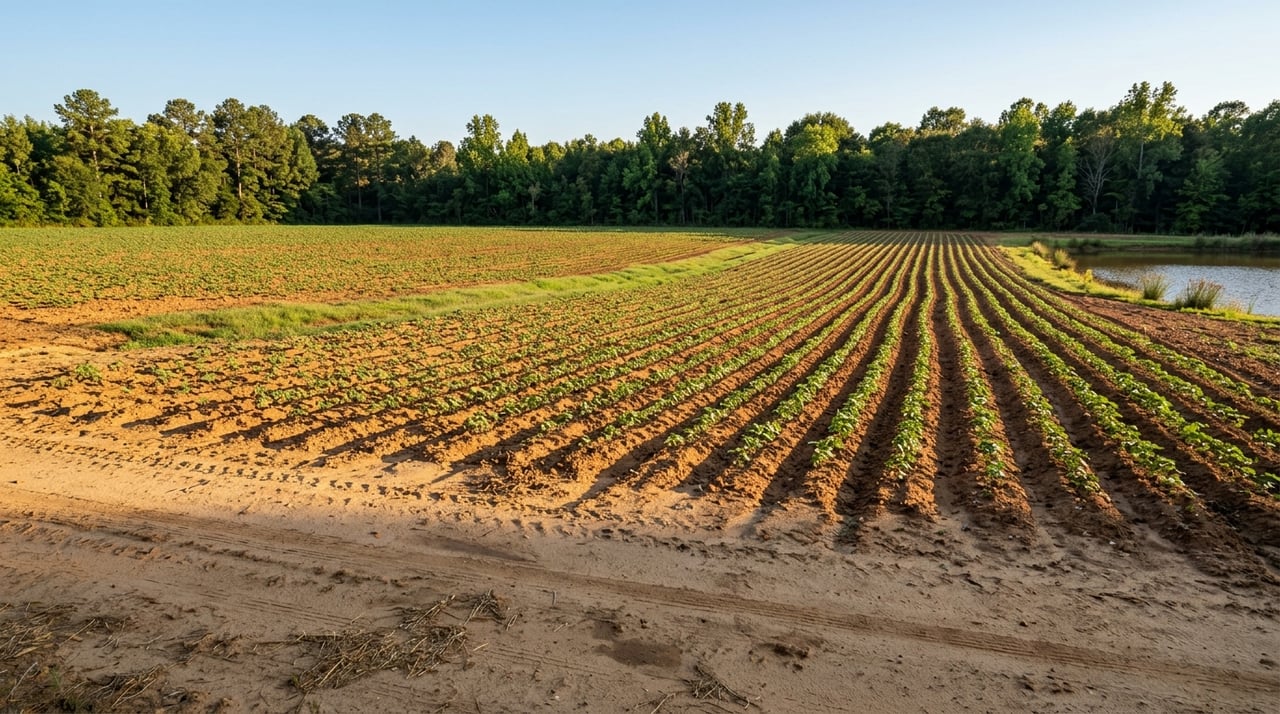
What makes one piece of farmland around Morgan worth more than another, even when the acre count looks similar? If you are buying, selling, or holding agricultural land in Calhoun County, that question matters because value here is shaped by more than just size. When you understand what local buyers tend to reward, you can price more confidently, spot risk sooner, and make better decisions. Let’s dive in.
Morgan land values start with local ag use
Around Morgan, agricultural land values are closely tied to how the land fits the county’s farm economy. According to the 2022 Census of Agriculture, Calhoun County had 144 farms covering 138,414 acres, with an average farm size of 961 acres. That tells you this is a market where working land plays a major role.
Crop production is especially important in the area. Crop sales made up 80% of farm sales in Calhoun County, while livestock, poultry, and related products made up 20%. In simple terms, land that supports productive crop use often has the strongest value position.
The county’s acreage mix helps explain why. Farms included 66,975 cropland acres, 7,320 pasture acres, 59,118 woodland acres, and 40,335 irrigated acres. When a large share of the local farm base is built around cropland and irrigation, buyers tend to look closely at whether a tract can compete in that same environment.
Crops help shape demand
The top reported crops by acreage in Calhoun County were cotton, peanuts, corn for grain, and forage or hay. That crop mix matters because it points to the type of land local operators are most likely to want. Tracts that fit row-crop production systems often attract more attention than land that is harder to farm efficiently.
That does not mean every property is judged the same way. Woodland, mixed-use tracts, and pasture can still have value, especially when they meet a buyer’s goals. But in the Morgan area, productive crop ground usually sets the tone for how agricultural land is judged.
Soil productivity is a major value driver
One of the first things buyers and lenders want to understand is soil quality. USDA guidance says farmland values are affected by parcel-specific traits like soil quality, and that cropland often trades at a premium to pastureland because it can produce higher per-acre returns. For you, that means the dirt itself is not just background information. It is one of the biggest parts of the value story.
In practical terms, stronger soils can support stronger pricing when they line up with local farming needs. Land with fewer limitations is generally easier to operate and easier to justify in a valuation. If the tract has notable soil challenges, buyers may adjust their offers to reflect the extra risk or cost.
What buyers look for in soil data
USDA NRCS says soil surveys help identify characteristics, limitations, and potential uses, including issues like seasonal wetness, flooding, and shallow depth. Those details can directly affect crop potential and field usability. Around Morgan, that makes soil map units and drainage classes important parts of any farmland review.
The current NRCS Web Soil Survey is the official source for up-to-date soil data and reports. For a buyer, it helps clarify what the land may be suited for. For a seller, it helps explain the tract on paper in a way that supports more informed pricing.
Irrigation and water access can lift value
In Calhoun County, irrigation is not a minor feature. The 2022 Census of Agriculture reported 40,335 irrigated acres, which equals 29% of land in farms. That is a strong signal that water access matters in this market.
If a tract already has irrigation or a credible path to irrigation, that can make it more attractive to buyers focused on crop production. Productive land with better moisture control often fits the county’s agricultural base better than marginal acres without that support. In many cases, this is one of the clearest dividing lines between stronger and weaker row-crop value.
Drainage matters too
Water access is only part of the picture. Drainage and field conditions also affect whether land is easy to farm and how reliable it may be in different seasons. A tract with usable drainage and fewer wet areas is usually easier to operate than one with recurring water issues.
That is why irrigation and drainage often need to be looked at together. Buyers are not just asking whether water is available. They are also asking whether the land can handle production in a practical, efficient way.
Field shape and usability affect pricing
Not all acres work the same. In a county with an average farm size of 961 acres, field efficiency matters. Larger, more regular fields are often easier to farm, easier to irrigate, and easier to support with an income-based valuation approach.
This does not mean a smaller or irregular tract has no value. It means buyers may compare it against land that is simpler to run with modern equipment. If a property has awkward corners, fragmented fields, or layouts that slow operations, that can lead to lower per-acre pricing.
Easy-to-farm land is easier to explain
One of the most practical valuation ideas is also one of the simplest. Land that is easy to farm is often easier to market, easier to underwrite, and easier to defend during pricing discussions. Around Morgan, usable layout is part of what helps separate premium land from discounted land.
That is especially true when the tract fits the county’s dominant crop systems. If the land’s shape, access, and field arrangement support cotton, peanuts, corn, or hay production, that tends to strengthen market appeal.
Access and infrastructure influence buyer demand
Road access matters because farm operations depend on moving equipment, inputs, and harvested crops. USDA ERS notes that parcel-specific attributes and urban proximity affect value, and Georgia’s freight system relies heavily on highways for direct access to logistics-enabled business activity. For farmland, that usually means paved frontage, truck access, and practical haul routes can all support value.
A tract that is hard to reach or awkward to enter may narrow the buyer pool. Even if the soils are strong, access problems can create real operating headaches. Good access does not guarantee top pricing, but poor access can absolutely hold a property back.
Morgan benefits from regional connections
Calhoun County’s location adds context here. The county describes itself as about 20 minutes from the Albany metro area, about 45 miles from Dothan, and about three hours from Atlanta. That regional position can matter because agricultural buyers often care about access to service centers, suppliers, repairs, and financing.
For you as a buyer or seller, this means the surrounding operating environment matters too. The land is not valued in isolation. It is part of a broader network of roads, services, and market access.
Existing leases can support or limit value
A lease can be an asset, but the details matter. USDA’s Southern Region land values release shows Georgia cropland cash rent averaged $153 per acre in 2024. In Calhoun County, 17 farms reported rented or leased land totaling 10,674 acres.
That tells you leased ground is part of the local agricultural picture. For buyers, a lease may offer income stability. For sellers, a well-documented lease can help support the story behind the asking price.
Lease quality matters more than lease existence
Not every lease improves value in the same way. A clear, dependable lease may help support buyer confidence, while short-term uncertainty or restrictive terms may do the opposite. Some buyers want immediate income, while others want operational flexibility.
That is why lease abstracts and lease terms are worth reviewing early. If you are pricing farmland around Morgan, the lease is not just a side note. It can change what a buyer is willing to pay.
What the Morgan market tends to reward
In broad terms, the Morgan-area market tends to reward land that is productive, usable, and straightforward. That usually means good soils, workable drainage, irrigation or water access, efficient field shape, and solid road access. It also means a tract that fits the county’s row-crop economy.
Because cotton, peanuts, corn, and hay are central to local acreage and sales, land that supports those uses tends to be easier for buyers to evaluate. It lines up with how the area already operates. When a tract checks several of those boxes, it often stands in a stronger position.
What can pull value down
Lower relative value often shows up when land is fragmented, wet, heavily wooded, difficult to access, or missing infrastructure needed for row-crop use. Woodland can still be valuable, but it may be priced differently than cropland. In Calhoun County, that matters because woodland makes up a large share of land in farms.
So if you are comparing two tracts with similar acreage, do not assume they should command similar prices. The market usually reacts to usability, not just size. The easier the land is to farm, reach, and document, the easier it is to support a stronger value.
What to verify before pricing farmland
Before you settle on a value opinion, it helps to build a practical property file. The research points to several items worth reviewing at the tract level. These records help buyers, lenders, and appraisers understand what they are actually looking at.
A useful file may include:
- NRCS soil maps
- A current survey
- Easement documentation
- Irrigation records
- Lease abstracts
- A clear look at highest and best use
This kind of preparation matters because farmland around Morgan is not just bought on appearance. It is judged on how well the land performs, how easily it can be operated, and how clearly those strengths can be shown on paper.
If you are selling, strong documentation can help reduce uncertainty. If you are buying, it can help you avoid overpaying for acres that do not match the story.
When you are trying to understand agricultural land values around Morgan, the big takeaway is simple: the market usually pays most for land that is easy to farm, easy to reach, and easy to explain. If you want help evaluating a tract, positioning land for sale, or thinking through highest and best use, Travis Ebbert offers practical guidance built around Georgia land and real-world property decisions.
FAQs
What drives agricultural land values around Morgan, Georgia?
- Around Morgan, key drivers include soil productivity, drainage, irrigation or water access, field shape, road access, lease quality, and how well the tract fits Calhoun County’s crop-focused farm economy.
How important is irrigation for farmland near Morgan?
- Irrigation is a meaningful factor because Calhoun County reported 40,335 irrigated acres in the 2022 Census of Agriculture, showing that water access plays a major role in local crop production.
Why do soils matter when pricing Calhoun County farmland?
- Soil surveys can show crop potential and identify limitations such as wetness, flooding, or shallow depth, all of which can affect how usable the land is and what buyers may pay.
Do field shape and layout affect Morgan-area farm values?
- Yes. Fields that are larger, more regular, and easier to operate with modern equipment are often more appealing than fragmented or awkwardly shaped tracts.
How do leases affect farmland value near Morgan?
- Existing leases can support value by adding income stability, but the lease terms matter because weak, uncertain, or restrictive leases may reduce buyer flexibility.
What documents should you review before pricing farmland in Morgan, GA?
- A practical review usually includes NRCS soil maps, a survey, easements, irrigation records, lease abstracts, and a clear understanding of the tract’s highest and best use.